
Feb 12, 2022
Flow - Variables
Variable:
Data Type Use to store... Text IDs, descriptions, and other text or long text data. Record Field values from a record, such as an opportunity. When this data type is selected, you create a record variable. Number A numeric value. Currency A currency value. Boolean A yes/no value, such as whether a checkbox was selected. Date A date value. Date/Time
A date and time value. Picklist
A picklist value. Multi-Select Picklist Picklist values, separated by semicolons. Apex-Defined
We can Store single values or collection values.
Screen Components
Screen components are available in three categories.
- Input includes standard components that request information from the user.
- Display includes standard components that display information to the user.
- Custom includes components that you or someone else have created. Install them from AppExchange or a third-party library, or work with a developer to build your own.
Action Types
Without creating or configuring anything else in Salesforce, you can use these actions.
- Post to Chatter.
- Send Email.
- Submit For Approval.
- Activate or Deactivate a Permission Set.
- Global or object-specific actions provided by Salesforce.
You can also include actions you create with clicks.
- Other flows in your org are available in the Subflow element.
- Custom global or object-specific actions are available in the Action element.
You can also include actions that require code. And you can install custom actions from AppExchange or a third-party library.
- To do something in the Salesforce database, build or install an Apex action.
- To do something in the browser, build or install a local action.
Aug 27, 2021
System.TypeException: Cannot have more than 10 chunks in a single operation. Please rearrange the data to reduce chunking.
System.TypeException: Cannot have more than 10 chunks in a single operation. Please rearrange the data to reduce chunking.
Cause:If we are doing DML operation on collection of sobject in single operation.1. More the 10 SobjectsList<Sobject> dmlList = new List<Sobject>();dmlList.add(New Account (Name='Test'));dmlList.add(New Contact (LastName='Test'));dmlList.add(New Lead (Name='Test'));dmlList.add(New opportunity (Name='Test'));dmlList.add(New custom1__c (Name='Test'));dmlList.add(New custom2__c (Name='Test'));...dmlList.add(New custom11__c (Name='Test'));insert dmlList;2. Less than 10 Sobjects and records in not in orderList<Sobject> dmlList = new List<Sobject>();dmlList.add(New Account (Name='Test'));dmlList.add(New Contact (LastName='Test'));dmlList.add(New Lead (Name='Test'));dmlList.add(New Account (Name='Test'));dmlList.add(New Contact (LastName='Test'));dmlList.add(New Lead (Name='Test'));...dmlList.add(New Account (Name='Test'));dmlList.add(New Contact (LastName='Test'));dmlList.add(New Lead (Name='Test'));insert dmlList;Solution:SImply Use SORT() methoddmlList.sort();insert dmlList;(OR)List<Sobject> dmlList = new List<Sobject>();dmlList.add(New Account (Name='Test1'));dmlList.add(New Account (Name='Test2'));..dmlList.add(New Account (Name='Test11'));dmlList.add(New Lead (Name='Test1'));dmlList.add(New Lead (Name='Test2'));..dmlList.add(New Lead (Name='Test11'));dmlList.add(New Contact (LastName='Test1'));dmlList.add(New Contact (LastName='Test2'));....dmlList.add(New Contact (LastName='Test11'));insert dmlList;
Jun 29, 2021
Salesforce Apex Coding Standards
Salesforce Apex Coding Standards
Coding Style
Indentation
·
Whitespace - Since Apex is case
insensitive you can write it your way. However, to increase readability, use four
spaces instead of tabs for indentation.
·
New Line – To increase readability – Use new
line at starting point for every new block.
·
Apex Class names should be in UpperCamelCase,
with the first letter of every word capitalized.
§ Eg: AccountTriggerHandler
·
Methods should be verbs in lowerCamelCase or
a multi-word name that begins with a verb in lowercase; that is, with the first
letter lowercase and the first letters of subsequent words in uppercase.
§
Eg: getParentAccount()
·
Variables: Local variables, instance
variables, and class variables are also written in lowerCamelCase.
§
Eg: Integer index, String accountName.
·
Final Varibale should be CAPITAL. Eg: final
Integer BATCHSIZE=20.
·
Variable names should not be single
characters.
·
Test Class name should be as PascalCaseTest.
i.e. – AccountTriggerHandlerTest
·
Test method should be as testShouldExecute<ClassName>When<data>
§
Eg: testShouldExecuteAccountTriggerHandlerWhenAddresschanged()
·
Datatype should be UpperCamelCase
§
Eg: String, Integer, List, Map, Wrapper,
Account, etc.
·
Boolean values Should be CAPITAL i.e.,
TRUE or FALSE.
ü
Remove the commented code as this is always a
blocker, while going through the code.
ü
Comments should tell WHY not WHAT.
ü
Git tracks history so no need to comment code.
Example:
instantiating an sObject using the sObject constructor vs the object.field
notation
|
SBQQ__Quote__c quote1 = new
SBQQ__Quote__c ( SBQQ__Opportunity2__c
= opp1.Id, SBQQ__MasterContract__c = c.Id, SBQQ__Primary__c = TRUE ); multiQuoteList.add(quote1); Vs SBQQ__Quote__c
quote1 = new SBQQ__Quote__c (); quote1.SBQQ__Opportunity2__c
= opp1.Id; quote1.SBQQ__MasterContract__c
= c.Id; quote1.SBQQ__Primary__c
= TRUE; multiQuoteList.add(quote1); |
Doesn't matter which convention you use, just keep it consistent within
the class.
ü
Make sure each method contains not more than 40
lines.
ü
If there are more lines break into multiple
methods.
ü
Classes no more than 10 methods or 300 lines.
ü
Don't add unnecessary code. Only the code needed
to achieve the feature you are working on
·
SELECT keyword and clauses such as
WHERE, WITH, GROUP BY, and ORDER BY, etc. all should be in CAPS.
·
Need to Break/new line for each
clause.
·
List all fields in ascending
alphabetical order.
|
[ Select Id, Name, customField1_c,
customField2_c from Account where Name like '%Nave%' ] |
·
Bad Practice
·
Good Practice
|
[ SELCT Id, Name, customField1_c, customField2_c FROM Account WHERE Name like '%Nave%' ] |
ü
Unless you absolutely need to debug something in
Production.
ü This also include Javascript console.log statements in front-end code.
Coding best practices
ü
There should be as little logic in your code as
possible.
ü
Write a single method and reduce the clutter in
your code.
ü
Simple code is easier to maintain.
ü
Bad Practice

ü
Good Practice

ü Bad Practice
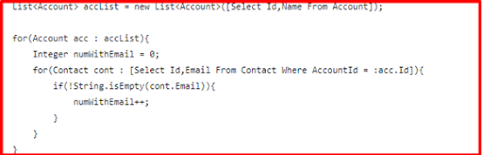
ü
Good Practice

ü Map<Id, sObject> myAwesomeMap =
new Map<Id,sObject>(List of sObjects or SOQL Query);


ü
Cover as close to 100% of the code as possible.
ü
Never use dummy code coverage
ü
Create all test data before calling the
Test.startTest method.
ü
Must have System.Assert for each test method.
ü
Include a description of expected behaviour as
2nd parameter for System.assert() or 3rd parameter for System.assertEquals()
ü
Examples:
ü
System.assert(A == B,’A does not equal B’);
ü
System.assertEquals(Expected,Actual,’Actual does
not equal Expected’);
ü
System.assertNotEquals(Expected,Actual,’Actual
equals Expected, but should not’);
ü
Avoid duplicated code (more-so in same class
than across classes)
ü
Use existed Trigger Framework, TestDataFactory
and HTTPMOCKClasses
ü
One Object should have one Trigger only
ü Use Custom Settings, metadata types
or custom Labels. (Or)
ü Get values dynamically
ü Bad Practice

ü Good Practice

ü Try to avoid more than 3 arguments
May 31, 2021
Can't Make A Callout to Own Salesforce from Lightning Component
Making API Calls from Apex(☑️ )/Java Script(❎)
- We can Make API calls from an Apex controller. You can’t make Salesforce API calls from JavaScript code.
- For security reasons, the Lightning Component framework places restrictions on making API calls from JavaScript code. To call third-party APIs from your component’s JavaScript code, add the API endpoint as a CSP Trusted Site.
- To call Salesforce APIs, make the API calls from your component’s Apex controller. Use a named credential to authenticate to Salesforce.
Note:
By security policy, sessions created by Lightning components aren’t enabled for API access. This prevents even your Apex code from making API calls to Salesforce. Using a named credential for specific API calls allows you to carefully and selectively bypass this security restriction.The restrictions on API-enabled sessions aren’t accidental. Carefully review any code that uses a named credential to ensure you’re not creating a vulnerability.
May 23, 2021
Summer ’21
LWC Quick Actions:
We can now use Lightning Web Components as Quick Actions! While you can currently do this with Aura Components, this new implementation brings some great new features! First off, there are TWO different types of LWC Quick Actions
- Screen Actions and
- Headless Actions.
Referece Link : Click Here
Aura Components in the ui Namespace Are Deprecated
- Salesforce is ending support for Aura components in the ui namespace on May 1, 2021
- Migrate to Lightning Web Components (LWC) whenever possibl
- Replace the deprecated components with their counterparts in the lightning namespace.
- These components are faster, more efficient, and they implement Lightning Design System styling out-of-the-box.
Example:
ui:actionMenuItem
Use lightning:menuItem with lightning:buttonMenu instead.
When migrating to Lightning Web Components, use lightning-menu-item with lightning-button-menu.
ui:inputText
Use lightning:input with text type instead.
When migrating to Lightning Web Components, use lightning-input with text type.
Referece Link : Click Here
May 20, 2021
USER PASSWORD FLOW
USER PASSWORD FLOW
API Authentication mechanism for Salesforce System
Salesforce APIs are authenticated. These APIs are accessible through the OAuth 2.0 Password authentication flow.
- {Domain} maybe
- Test.salesforce.com --> Sandbox
- Login.salesforce.com --> production
API URL: https://{Domain}/services/oauth2/token
Access Mechanism: OAuth2.0.
Request Method: POST
Request from third party :
Success Response from Salesforce:
Error Response from Salesforce:
Subscribe to:
Comments (Atom)
-
VF Page Creation
-
Issue: Unable to add new lines/Products if already added more than 100 Backend debug log |FATAL_ERROR|System.QueryException: Aggregate query...
-
System.TypeException: Cannot have more than 10 chunks in a single operation. Please rearrange the data to reduce chunking. Cause: If...
